
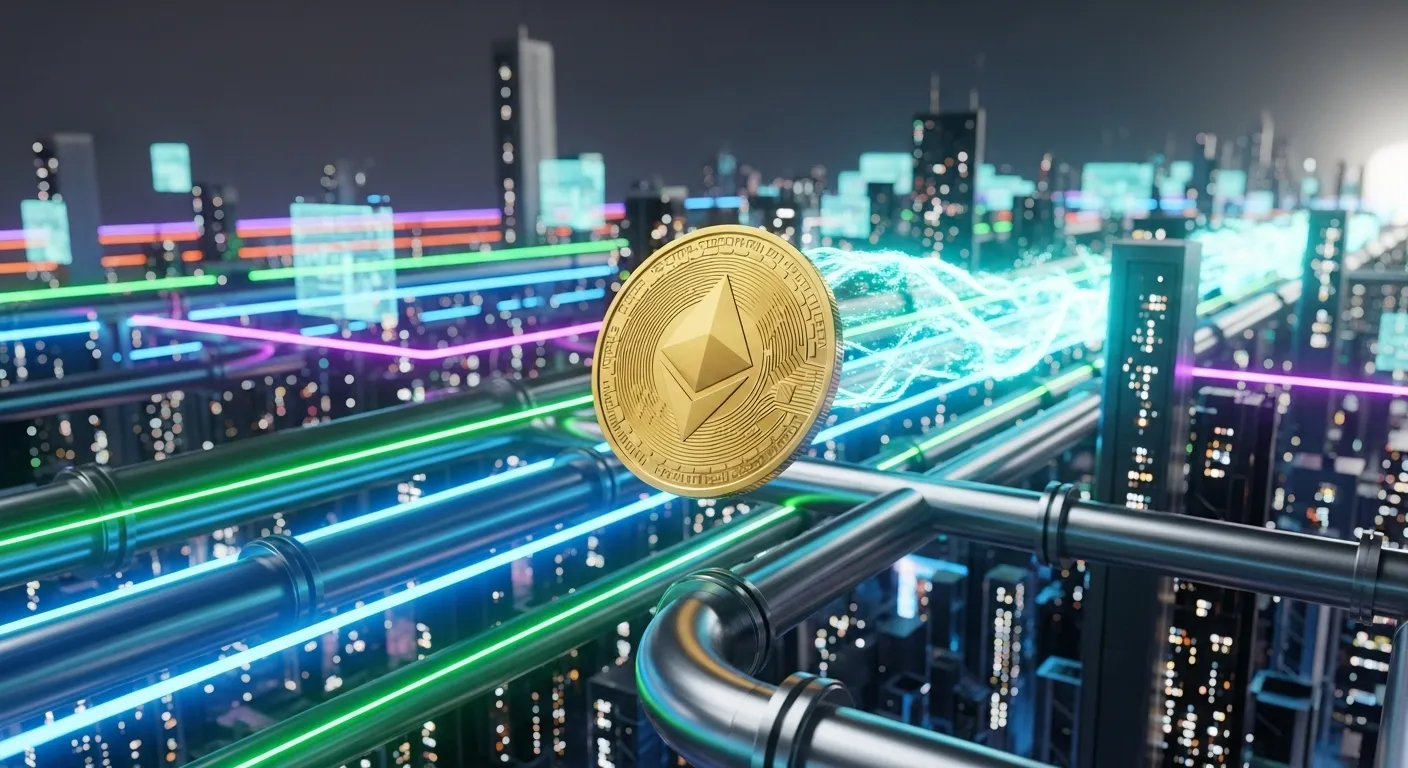
In the heart of the crypto world, where innovation and volatility dance hand in hand, Ethereum always shines like a steadfast star. It's October 15, 2025, and ETH hovers around 4,130 – a figure that whispers of stabilization after a bitter pullback. The recent market plunge, which erased over 19 billion in market value, left everyone wondering: is this just a deep breath before the next surge, or a harbinger of storms ahead? The answer, as is often the case with Ethereum, is complex and multifaceted, rooted in its robust technological advancements, the shifting tides of traditional finance, and the relentless expansion of its ecosystem.
***
ETF Dynamics and Institutional Embrace
Ethereum's fundamental analysis extends far beyond its price; it’s centered on the powerful ecosystem it fosters, which cradles the Decentralized Finance (DeFi) revolution, Non-Fungible Tokens (NFTs), and Layer 2 (L2) scaling solutions. A critical development shaping its trajectory is the emergence of Ethereum Exchange-Traded Funds (ETFs). The regulatory green light for these investment vehicles has unlocked the floodgates for substantial institutional capital, fundamentally altering the market's structure. October began with strong inflows, approximately 1.48 billion in the first week, signaling massive institutional appetite for easily accessible digital assets. However, sudden and significant outflows, such as the 428 million withdrawal on October 13, momentarily rattled the market. This volatility underscores that even large institutional investors are highly sensitive to broader macroeconomic and geopolitical events. Yet, the swift return of capital, highlighted by 236 million in inflows on October 14, with Fidelity alone acquiring 154 million in ETH, suggests these dips are seen as prime buying opportunities rather than a definitive reversal. This tug-of-war reflects a larger narrative: institutions are engaging, and their participation forms a bedrock for Ethereum's long-term demand. Furthermore, the supply of ETH on exchanges has plummeted to a 9-year low, a clear bullish signal indicating long-term holders are accumulating and minimizing immediate selling pressure.
***
Network Evolution and the Fusaka Upgrade
The Ethereum network itself is a dynamic, evolving powerhouse engine. The current focal point for its development is the forthcoming Fusaka upgrade. This significant update, successfully tested on the Sepolia testnet and scheduled for the mainnet in December, carries substantial promise for the network's capacity and cost-efficiency. The most notable feature is the planned increase in the gas limit to 150 million, which directly boosts the network's throughput capacity. Additionally, Fusaka will significantly reduce L2 transaction costs through the implementation of PeerDAS (Peer-to-Peer Data Availability Sampling). These technical enhancements are crucial not just for scaling but also for making Ethereum a vastly more appealing platform for both developers and end-users. Improved scalability is the catalyst for exponential growth across various sectors. The Total Value Locked (TVL) in Ethereum's DeFi ecosystem now surpasses $90 billion, a testament to the market’s profound trust in its underlying infrastructure. On-chain activity mirrors this growth: daily transactions hover around 1.6 million, and the Proof-of-Stake (PoS) mechanism, through staking, has effectively curtailed the circulating supply of ETH, introducing a deflationary element. With the transition away from PoW mining, the network boasts over 1 million validators, ensuring unparalleled security and decentralization. Ethereum has transcended its original role as a simple smart contract platform; it is now the essential hub for major innovations, including Real-World Assets (RWAs) and complex Artificial Intelligence (AI) projects, all requiring a robust and scalable blockchain foundation. This architectural maturity positions Ethereum perfectly for the next wave of Web3 adoption.
***
Macroeconomic Tailwinds and Competitive Landscape
Broader macroeconomic factors continue to exert a powerful influence on Ethereum’s valuation. Interest rate cuts by the Federal Reserve are redirecting liquidity away from low-risk instruments towards higher-risk assets like ETH. Persistent inflation across major economies further burnishes Ethereum's appeal as an inflation hedge and validates its title as 'digital oil' the indispensable fuel for the decentralized global economy. Furthermore, global adoption is accelerating at an impressive clip. Corporations like MicroStrategy are actively diversifying their treasury portfolios to include ETH, and nations like El Salvador are pioneering inspiring models for digital asset integration. However, the path is not without its hurdles. The fierce competition from other Layer 1 blockchains, most notably Solana, which are competing aggressively for TVL and developer mindshare, presents a genuine market challenge. Ethereum has successfully maintained its dominance as the premier smart contract platform by strategically leveraging its powerful L2 ecosystem, featuring leaders like Arbitrum and Optimism. This 'rollup-centric' strategy allows Ethereum to achieve the necessary scalability for mass adoption while strictly preserving the high security and decentralization standards of its base layer.
***
Market Sentiment and Future Outlook
The latest market correction, which some analysts attribute to unforeseen geopolitical shocks, resulted in a 20 billion reduction in Open Interest (OI) within the derivatives market. The widely followed Fear & Greed Index dipped to a reading of 30, signaling 'moderate fear' among market participants. While these corrections are painful, historical data from the crypto market often shows they are necessary preludes to strong, sustained rallies. Analysts frequently cite historical October performance, noting that ETH has averaged a robust 4.77% gain during this month. Near-term to long-term price forecasts are overwhelmingly positive. Predictions for October range from 4,300 to 5,200. For the full year 2025, top analysts project ETH could reach up to 10,000, representing a potential Return on Investment (ROI) of 90% from current levels. Noted figure Tom Lee has even put forth a target of $16,000 by year-end. The ripple effects of Bitcoin’s halving event are also keenly felt by Ethereum, with Altseason signals flashing a reading of 70, suggesting that altcoins are poised for outperformance relative to Bitcoin.
Nonetheless, a grounded perspective is essential: in the highly volatile crypto sphere, no outcome is ever guaranteed. A decisive break below the critical 3,900 support level could quickly lead to a retest of the 3,600 mark. Technical indicators reflect the current indecision: the Relative Strength Index (RSI) is neutral at 48, and the Moving Average Convergence Divergence (MACD) is flattening. Encouragingly, large-scale investors, or 'whales,' show signs of accumulation, and Decentralized Exchange (DEX) volume has increased by 47%, a strong indicator of underlying ecosystem health. The core question remains: will the Fusaka upgrade provide the definitive spark needed to propel ETH past the critical $5,000 resistance, or will persistent, though often temporary, ETF outflows continue to restrain its ascent?
Ultimately, Ethereum on October 15, 2025, is more than just a digital asset; it is the fundamental infrastructure upon which the future of Web3 is being built. Despite periodic market challenges, the solid fundamentals from institutional ETF adoption to continuous network upgrades paint a robust and decidedly bullish picture. For investors, the long-standing strategy of 'Buy the Dip' and HODL (Hold On for Dear Life) remains the pragmatic approach. The markets are full of surprises, but adhering to strong foundational principles is the key to enduring success. This current bout of volatility may well be the bridge to an $8,000 price point only time will reveal the full extent of its journey.
Market Analysis
Bullish
80%
The article forecasts a bullish long-term trend for Ethereum, highlighting technical upgrades and institutional adoption, while noting ETF volatility as a short-term risk.
Key Points:
- ETF Inflows
- Fusaka Upgrade
- DeFi TVL
- Institutional Adoption
- Macro Variables
Frequently Asked Questions
Common questions about this topic
What is Ethereum's current price on October 15, 2025?
Ethereum is trading around $4,130, indicating stabilization after a recent pullback.
Why are ETF inflows important?
ETF inflows signal institutional adoption and enhance liquidity, though outflows can spark volatility.
What impact does the Fusaka upgrade have?
Fusaka boosts L1 throughput and cuts L2 costs, improving scalability.
Is the long-term trend bullish?
Yes, with rising TVL and forecasts up to $10,000, the outlook remains positive.
What are the short-term risks?
Recent ETF outflows and market swings could drag prices to $3,900 support.